Presented by George Simte — Lead Mentor, Ad Campaign Academy (ACA-LAMKA)
on-page and off-page SEO, Search Engine Optimization (SEO) is one of the most important digital marketing skills for businesses, bloggers, website owners and marketing professionals. A successful SEO strategy is not based on only adding keywords to a webpage. It involves improving the website itself, creating useful content, building authority and earning trust from search engines and users.
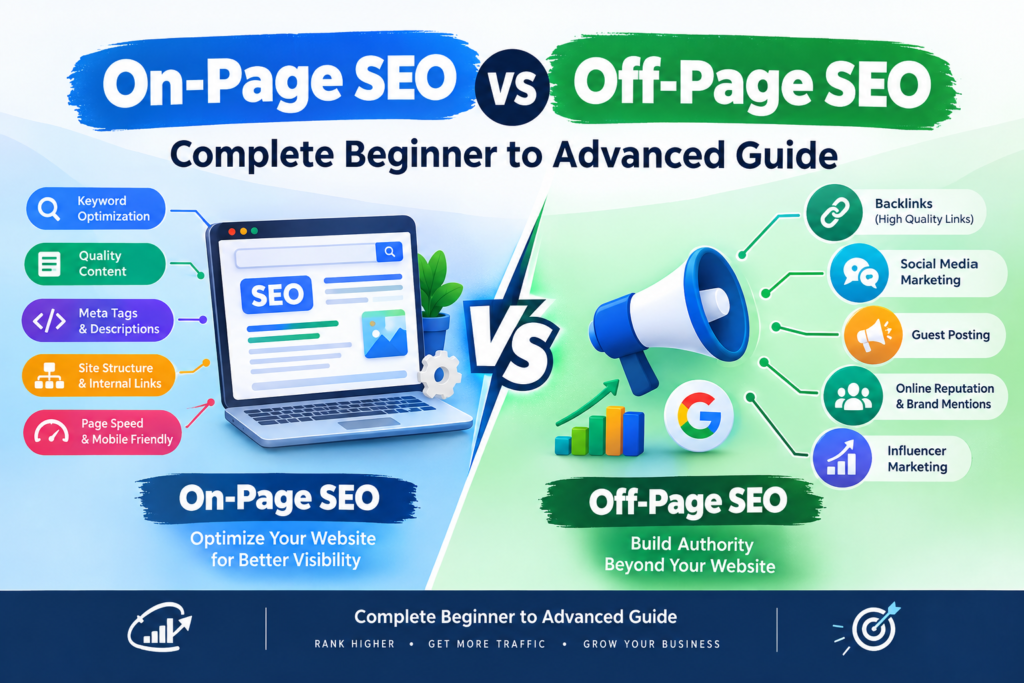
Two major areas of SEO are On-Page SEO and Off-Page SEO.
In simple terms:
On-Page SEO = What you improve on your own website.
Off-Page SEO = What you do outside your website to build authority, visibility and trust.
This guide explains both techniques from beginner to advanced level with practical examples.
What Is On-Page SEO?
On-page SEO refers to optimizing the content and technical elements of individual webpages so search engines can better understand their topic and users can easily consume the information.
Important on-page SEO elements include:
- SEO-friendly titles
- Headings
- Keywords
- Content quality
- Meta descriptions
- URLs
- Internal links
- Images and alt text
- Content structure
- Search intent
- Mobile usability
- Page speed
- Structured data
Example of Basic On-Page SEO
Suppose you operate a digital marketing institute in Lamka.
Instead of creating a page with a generic title:
“Our Course”
You could create a more descriptive title:
“Digital Marketing Course in Lamka, Manipur | ACA-LAMKA”
The second title provides users and search engines with more context about the page.
1. Keyword Research
Keyword research is the foundation of effective on-page SEO.
Beginners should identify keywords that potential customers actually search for.
For example:
Primary keyword:
Digital marketing course in Lamka
Related keywords:
- Digital marketing course in Manipur
- Digital marketing institute in Lamka
- Digital marketing training in Churachandpur
- professional digital marketing course
- digital marketing course with internship
Advanced SEO goes beyond simply collecting keywords. You should understand search intent.
Four Common Search Intents
Informational:
“What is SEO?”
Navigational:
“ACA-LAMKA”
Commercial investigation:
“Best digital marketing course in Manipur”
Transactional:
“Join digital marketing course in Lamka”
Creating content that matches the searcher’s intent can make your SEO strategy much more effective.
2. SEO-Friendly Title
Your page title should clearly describe the content.
For example:
Weak:
“SEO Tips”
Better:
“On-Page SEO Tips for Beginners”
More targeted:
“On-Page SEO: Beginner to Advanced Guide with Examples”
Avoid stuffing the title with repeated keywords.
3. Meta Description
A meta description summarizes a webpage for users viewing search results.
Example:
“Learn on-page and off-page SEO from beginner to advanced level with practical examples, keyword research, link building and optimization strategies.”
A good description should communicate the value of the page and encourage relevant users to click.
4. Heading Structure
Use headings to organize your content.
A basic structure could be:
H1: On-Page and Off-Page SEO Guide
H2: What Is On-Page SEO?
H2: On-Page SEO Techniques
H3: Keyword Research
H3: Internal Linking
H3: Image Optimization
H2: What Is Off-Page SEO?
H2: Off-Page SEO Techniques
This structure helps readers scan the article and makes the topic easier to understand.
5. Content Optimization
SEO content should answer the user’s question comprehensively. off-page SEO techniques
For example, if the target keyword is:
“SEO service in Churachandpur”
A useful page could explain:
- What SEO services include
- Local SEO
- Google Business Profile optimization
- Technical SEO
- Keyword research
- Content marketing
- Reporting
- Expected timelines
- Frequently asked questions
Avoid writing hundreds of words simply to increase word count.
Helpful content is more important than unnecessary length.
6. Internal Linking
Internal links connect pages within your own website.
For example:
A blog about keyword research can link to:
SEO Services → Digital Marketing Course → Contact Page
A good internal linking structure helps users discover related content and helps search engines understand relationships between pages.
Advanced Internal Linking Example
Imagine you have these pages:
/seo//local-seo//keyword-research//technical-seo//seo-course/
Your keyword research article could link naturally to the SEO service page and technical SEO guide.
This creates a stronger content structure.
7. Image SEO
Images should also be optimized.
Instead of:
IMG12345.jpg
use:
on-page-seo-guide-beginners.jpg
Example alt text:
“On-page SEO optimization checklist for beginners”
Image optimization can also include:
- Appropriate file format
- Compressed images
- Descriptive filenames
- Relevant alt text
- Responsive images
- Appropriate dimensions
8. URL Optimization
Keep URLs short, descriptive and relevant.
Poor URL:
website.com/page?id=12345
Better:
website.com/on-page-seo-guide/
Avoid unnecessary words and complicated URL structures.
What Is Off-Page SEO?
Off-page SEO includes activities outside your website that can help build your website’s authority, reputation, visibility and relationships.
Common off-page SEO activities include:
- Link building
- Digital PR
- Brand mentions
- Guest contributions
- Business citations
- Local directories
- Partnerships
- Community participation
- Content promotion
- Reviews
- Social distribution
The most well-known component is backlink building.
What Is a Backlink?
A backlink is a link from another website to your website.
For example:
A local business publication writes an article about digital marketing institutes in Manipur and links to your website.
That link is a backlink.
However, not every backlink has the same value.
A relevant, trustworthy link can be more useful than many unrelated or low-quality links.
Beginner Off-Page SEO Example
Suppose you own a digital marketing academy.
You could start by creating accurate business profiles on relevant platforms and directories.
You can also:
- Build local citations
- Encourage genuine customer reviews
- Publish useful content
- Share educational resources
- Build relationships with local businesses
- Participate in relevant professional communities
The goal is to build a genuine online presence rather than simply collecting links.
Intermediate Link Building
Once you understand the basics, you can explore more structured link-building strategies.
1. Guest Contributions
Create genuinely useful content for relevant websites.
For example:
A digital marketing professional could contribute an article about:
“How Local Businesses Can Use SEO to Generate Leads.”
The article may include an appropriate author or resource link where permitted.
2. Digital PR
Create content that journalists, publishers or industry websites may find valuable.
Examples include:
- Original research
- Industry reports
- Surveys
- Local business studies
- Expert commentary
- Data-driven articles
If publishers reference your research, they may link to your website.
3. Resource Link Building
Create genuinely useful resources such as:
- SEO checklists
- Marketing templates
- Industry guides
- Statistics pages
- Tutorials
- Calculators
Other websites may naturally reference useful resources.
Advanced Off-Page SEO
Advanced SEO focuses less on obtaining random links and more on building authority, relevance and brand recognition.
Digital PR + SEO
Suppose an academy publishes a local study:
“Digital Marketing Skills Employers Need in Manipur.”
If the research contains useful original data, local publications and industry websites may reference it.
This can generate:
- Brand mentions
- Referral traffic
- Backlinks
- Professional credibility
Topical Authority
Instead of publishing one article about SEO, create a complete content ecosystem.
For example:
SEO Pillar Page
→ Keyword Research
→ Technical SEO
→ On-Page SEO
→ Off-Page SEO
→ Local SEO
→ Link Building
→ SEO Analytics
→ SEO Tools
This helps establish comprehensive topical coverage.
On-Page SEO vs Off-Page SEO
| On-Page SEO | Off-Page SEO |
|---|---|
| Website optimization | External website activities |
| Content optimization | Authority building |
| Keywords | Backlinks |
| Titles | Digital PR |
| Headings | Brand mentions |
| Internal links | Citations |
| Image optimization | Reviews |
| URL optimization | Content promotion |
| Technical improvements | Relationship building |
The two strategies work together.
A website with excellent backlinks but poor content may provide a poor user experience.
Likewise, a technically excellent website with no authority or visibility may struggle to compete for competitive search terms. on-page and off-page SEO
Beginner-to-Advanced SEO Roadmap
Level 1: Beginner
Learn:
- SEO fundamentals
- Keyword research
- Search intent
- Titles
- Meta descriptions
- Headings
- Basic content optimization
- Internal links
- Image SEO
Level 2: Intermediate
Learn:
- Technical SEO
- Local SEO
- Google Search Console
- Google Analytics
- Content clusters
- Competitor analysis
- Backlink analysis
- SEO audits
- Structured data
Level 3: Advanced
Learn:
- Advanced technical SEO
- Enterprise SEO concepts
- Digital PR
- Advanced link acquisition
- Topical authority
- International SEO
- E-commerce SEO
- JavaScript SEO
- Log-file analysis
- Advanced analytics
- SEO automation
- AI-assisted SEO workflows
Practical SEO Project Example
Imagine you want to rank a website for: SEO for beginners
“Digital Marketing Course in Lamka.”
Step 1: Keyword Research
Identify relevant primary and supporting search terms.
Step 2: Create the Landing Page
Build a useful page explaining:
- Course duration
- Modules
- Practical training
- Internship
- Eligibility
- Projects
- Certification
- FAQs
- Enquiry process
Step 3: Optimize On-Page SEO
Optimize:
- Title
- H1
- H2 sections
- URL
- Meta description
- Images
- Internal links
- Structured data
Step 4: Build Local Relevance
Improve:
- Business information
- Local citations
- Google Business Profile
- Genuine customer reviews
- Local content
Step 5: Promote the Content
Share useful educational resources through relevant channels and build relationships with local organizations, publications and businesses. on-page and off-page SEO
Step 6: Measure Results
Monitor:
- Search impressions
- Clicks
- Rankings
- Organic traffic
- Leads
- Conversions
- Backlinks
- Engagement
SEO should be measured by business outcomes, not rankings alone.
Common SEO Mistakes to Avoid
Beginners often make several mistakes:
- Keyword stuffing
- Buying large quantities of backlinks
- Copying competitors
- Creating thin content
- Using irrelevant backlinks
- Ignoring technical SEO
- Ignoring mobile users
- Publishing without understanding search intent
- Using misleading titles
- Expecting immediate results
SEO is a long-term process. Sustainable growth normally comes from consistently improving content, technical quality, authority and user experience.
Final Thoughts
On-page SEO and off-page SEO are complementary parts of a complete SEO strategy.
On-page SEO helps search engines understand and users experience your website. Off-page SEO helps build reputation, authority and visibility beyond your website. on-page SEO techniques
For beginners, start with keyword research, search intent, quality content, titles, headings and internal linking. As your skills improve, move into technical SEO, local SEO, analytics, digital PR, authority building and advanced SEO strategies.
Learn the fundamentals. Practise with real projects. Analyse the results. Improve continuously.
Presented by George Simte — ACA-LAMKA
At Ad Campaign Academy (ACA-LAMKA), learners can develop practical digital marketing skills covering SEO, Google Ads, Meta Ads, WordPress, e-commerce, analytics, content marketing, AI marketing and other professional skills through project-based learning.
Your SEO journey can follow a simple roadmap:
Learn → Practise → Build Projects → Analyse → Optimise → Grow
Frequently Asked Questions About On-Page and Off-Page SEO
1. What is the difference between on-page SEO and off-page SEO?
On-page SEO involves optimizing elements on your own website, including content, keywords, headings, URLs, images, internal links and technical performance. Off-page SEO focuses on activities outside your website, such as link building, digital PR, citations, brand mentions and reputation building.
2. Which is more important: on-page SEO or off-page SEO?
Both are important and work together. On-page SEO helps search engines understand your website and helps users find useful information, while off-page SEO can help build authority and credibility. A strong SEO strategy should address both.
3. What are some examples of on-page SEO?
Examples include keyword research, search-intent optimization, SEO titles, meta descriptions, H1/H2 headings, useful content, internal linking, image optimization, SEO-friendly URLs, structured data and improving page experience.
4. What are some examples of off-page SEO?
Off-page SEO examples include earning quality backlinks, digital PR, relevant business citations, genuine reviews, brand mentions, content promotion, industry relationships and contributing useful content to relevant websites.
5. How do backlinks help SEO?
A backlink is a link from another website to your website. Relevant and trustworthy backlinks can help demonstrate authority and may contribute to stronger search visibility. However, quality and relevance are more important than simply collecting a large number of links.
6. Can a new website rank on Google without backlinks?
Yes. A new website can potentially rank for relevant searches without having many backlinks, particularly for less competitive topics. Strong content, search-intent alignment, technical SEO and useful user experience are important. Backlinks can become more valuable as you compete for more competitive keywords.
7. How long does SEO take to show results?
SEO does not have a guaranteed timeline. Results can vary depending on competition, website quality, content, technical issues, authority and the search query. Some pages may gain visibility relatively quickly, while competitive keywords can require consistent optimization and content development over a much longer period.
8. What should a beginner learn first in SEO?
A beginner should start with SEO fundamentals, keyword research, search intent, on-page optimization, content creation, internal linking, basic technical SEO and Google Search Console. After understanding these fundamentals, they can progress to local SEO, link building, analytics and advanced SEO.
9. Is keyword stuffing good for SEO?
No. Repeating keywords unnaturally can make content difficult to read and may be considered a poor SEO practice. Use keywords naturally while focusing on answering the user’s search intent and providing genuinely useful information.
10. Can SEO be used for local businesses?
Yes. Local SEO can help businesses improve their visibility for location-based searches. Important activities can include optimizing local landing pages, maintaining accurate business information, managing a Google Business Profile, earning genuine reviews, creating locally relevant content and building relevant local citations.
11. What tools can beginners use to learn SEO?
Beginners can explore tools such as Google Search Console, Google Analytics, Google Trends, Google Keyword Planner, Semrush, Ahrefs, Moz and other SEO platforms. The important part is learning how to interpret the data rather than simply collecting reports.
12. Can I learn on-page and off-page SEO as part of a digital marketing course?
Yes. A professional digital marketing course can teach on-page SEO, technical SEO, keyword research, local SEO, content optimization, link-building concepts, analytics and practical SEO projects. At ACA-LAMKA, these skills can be incorporated into a broader digital marketing learning roadmap under the guidance of George Simte.
Final SEO Takeaway
Whether you are a beginner, website owner, freelancer or aspiring SEO professional, understanding both on-page SEO and off-page SEO is essential.
Start with the foundation:
Keyword Research → Search Intent → Quality Content → On-Page SEO → Technical SEO → Off-Page SEO → Analytics → Continuous Optimization
The more you practise with real websites and projects, the stronger your SEO skills become.
Presented by George Simte — Lead Mentor, Ad Campaign Academy (ACA-LAMKA).
Table of Contents
Course Fees in LAMKA
ACA – LAMKA- Google digital marketing
- Free Hosting
- SEO PPC
- Website and ecommerce
- Job support
Visit on social media
https://www.youtube.com/@adcampaignacademy
https://www.facebook.com/adcampacademy
https://www.instagram.com/adcampacademy
https://www.reddit.com/user/digitalmang44